
Company
About Us
Bellcraft was established in 2000, drawing on the experience of brothers Elia and Alfredo Belluomini, who have been active in the shipbuilding industry since the 1980s.
Born from a passion for constructing fiberglass vessels, the company has evolved over time, specializing in the design and build of professional craft for port technical and nautical services.
Today, Bellcraft produces pilot boats, mooring boats, and other workboats designed to meet the operational requirements of harbor pilots, mooring crews, and boatmen. Each unit is developed with a sharp focus on safety, reliability, ergonomics, and operational continuity, essential factors for those who work at sea every day.
In addition to building new vessels, the shipyard carries out refits, modernizations, and technical upgrades, helping to maintain the efficiency, performance, and value of these maritime assets over time.
From initial design to final delivery, every project is shaped by direct consultation with the client and the expertise gained through hands-on experience in the field. Our goal is to build robust, functional, and long-lasting vessels capable of reliably handling the challenges of port operations.
A passion for the sea. Attention to detail. This is Bellcraft.


It employs qualified drafters and engineers.
The shipyard operates out of 2,000 square meters of covered sheds, an 800-square-meter building housing a workshop and warehouses, and 1,500 square meters of open yard space; it also includes approximately 200 square meters dedicated to offices and an exhibition area.
It is equipped with its own vehicles for transporting vessels for launching and hauling out at the Port of Viareggio.
The Story
Bellcraft began a collaboration with the shipyard Tecnokappa/Kappamarine to build workboats, vessels now found in numerous ports across Italy and abroad.
Subsequently, Bellcraft acquired the molds and designs for the Kappamarine line, incorporating them into its own brand. The company has since expanded this range with new designs and builds, offering a broader array of solutions for applications such as pilotage, mooring, boat transport services, and other specialized operations, including cargo transport, pollution control, and more.
Our production has evolved, drawing not only on our own accumulated expertise but, most importantly, on the experience of our clients. We tailor the outfitting of each vessel to its intended use and the specific requirements of the customer.


BUILT FOR WORK
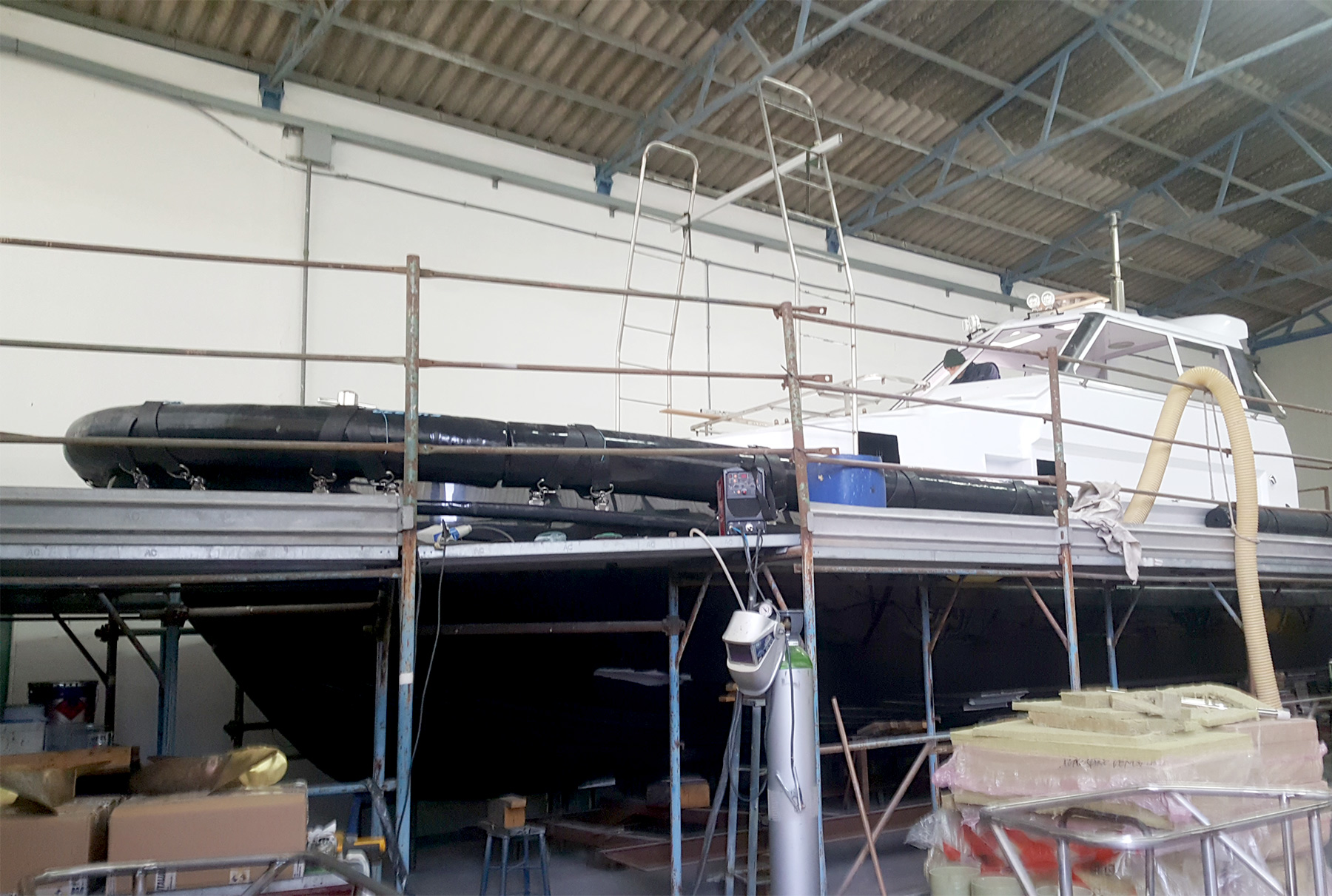
The care we put into our construction process begins at the preliminary design stage, where we work with our client to anticipate everything they need to carry out port operations safely and efficiently, such as handrails, safety ladders, fenders, bollards, towing hooks, and more. This initial assessment is crucial for designing the fiberglass structures, which are engineered with specific reinforcements at the exact points where equipment and fittings (bollards, towing hooks, fenders, external ladders, cranes, etc.) will be installed.
Great attention is devoted to the construction of the vessel’s fiberglass hull, as it is the very essence of the craft. The hull, comprising both the underwater portion and the sides, is built using neopentyl-based gel coats and vinyl ester resins in the initial layers, creating a protective barrier and significantly strengthening the overall structure.
We carry out continuous monitoring throughout the lamination process to ensure that all required thicknesses and reinforcements, as specified for this type of vessel, are strictly maintained. Within the hull plating, a network of longitudinals and stringers creates a robust structure, capable of withstanding the most demanding operations.
All structural framing includes limber holes to allow for water drainage. The superstructures and deck are constructed using isophthalic resins in a sandwich configuration to enhance strength; furthermore, specific reinforcements, incorporating wood inserts, are applied at key stress points where hardware or accessories are to be installed.



For every build, we send core samples of the fiberglass laminate to a specialized laboratory to verify that the required certification parameters, such as strength, tensile properties, and breaking point, are met. The assembly of the fiberglass deck and hull sections is carried out with great precision: first, the components are secured using a series of perimeter pins; subsequently, these are filled, and the sections are bonded together with multiple layers of resin to create a single, unified structure comprising the hull and deck. We then integrate the hull’s internal structural framework with the deck, forming a continuous reinforcing arch.
Our boats are conceived, engineered, and built for hard work, designed to withstand even the most demanding conditions. In consultation with our clients, and taking into account their preferred brands, we select the engine and reduction gear setup best suited to the specific vessel under construction. The installation of engines and onboard systems, both hydraulic and electrical, is optimized for maximum performance and safety, while also ensuring ease of future maintenance and repairs.
Every Bellcraft vessel is the result of combining expert craftsmanship with practical operational requirements, creating a unique craft designed specifically for those who will use it day in and day out.
Our Solutions
- We offer a variety of cabin and superstructure configurations that can be adapted to any specific operational requirement;
- Large hatches are provided to facilitate the removal of engines;
- Fuel tanks can be removed from the vessel;
- Bilge systems are constructed using rigid stainless steel piping, in compliance with current regulations;
- Seawater intakes are fitted with bronze or cupronickel connectors and piping;
The fuel supply system consists entirely of rigid piping, made from a combination of stainless steel and copper; - The rudders feature long stocks extending above the waterline, enhancing both safety and durability;
- The onboard electrical system is streamlined and logical: all components are connected via marine-grade cabling to a numbered terminal block, allowing for easy inspection, and to an electrical panel equipped with circuit breakers that protect all lines and equipment;
- All vessels are treated internally with a self-extinguishing gel coat;
They are equipped with fire-suppression systems, including shut-off dampers and modern inert-gas-based fire-extinguishing systems that are harmless to personnel; - Cabin interior linings are made of plastic-based materials, ensuring greater longevity;
- Windows are constructed from tempered, laminated glass, bonded into recessed frames (frameless design).
Every port-based operation has its own methods and routines or, more precisely, its own specific type of work, which is why, whenever we are commissioned to build a vessel, we work closely with the client to design and outfit it in a way that best meets their particular needs.
